Quick and Easy Way to Effective Speaking Dale Carnegie Summary
Book review : The Quick and Easy Way to Effective Speaking
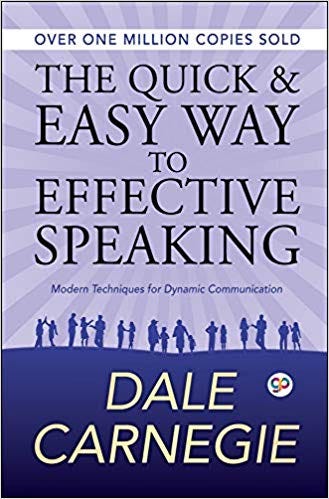
One-sentence summary of the book "The Quick and Easy Way to Effective Speaking" : Being eloquent or charismatic is not something innate, it can be learned, and Dale Carnegie shows how everyone can become a talented speaker in public with training and the application of some simple techniques, regardless of your level of studies.
By Dale Carnegie, Dorothy Carnegie and Didier Weyne (translation) 1992 (reissue), 215 pages.
Note: this review is a guest review written by Claire of the blog Univoix.
What are the benefits of knowing how to speak in public?
Public speaking can be terrifying for many of us. Even big business leaders such as Tim Ferris and Elon Musk have expressed their fear of effective speaking directly to an audience. But they have overcome their fear and are now managing the challenges that come with communicating to a large group.
Communicating well is an essential element of success and knowing how to make a presentation or speech is an integral part of it. In your entrepreneurial career, you will likely be called to speak in front of an audience. Of course, we do not all have the extraordinary talent of the hyper-charismatic speaker Anthony Robbins, but let's see how developing public effective speaking can move you forward.
8 things that happen to you when you speak in public:
- It helps you overcome your fears
- Your voice is relaxed, and you have a better tone during your normal conversations
- You develop more charisma
- Your self-confidence grows
- It helps to develop your general communication skills
- It's easier for you to build an image
- Your contact network benefits greatly
- It gives a big boost to your career
- You inspire others to build their dream
- You become aware of the importance of marketing yourself
Review and summary of "The Quick and Easy Way to Effective Speaking":
If you prefer video to text, I have prepared an illustrated review of the book in video format 🙂:
One tends to imagine that eloquence is a gift, whether one is or isn't a good speaker. The reality is that like everything else, we are not born competent, we become so. And Dale Carnegie, completely removes our inhibitions with the art of public speaking. Reading it, one realizes that knowing how to speak in public, and making it a success, is feasible and accessible to all.
And that's really what made the success of his writings and his training programs. As he does not consider eloquence as an art, reserved for an elite, but as a technique accessible to everyone, which is resolutely modern for the time (his first public effective speaking classes date from 1912).
His techniques are now widespread both in political speech and in the world of sales, for example. Dale Carnegie has also influenced many copywriters because some of his formulas are applicable both orally and in writing.
Thus, through this book about eloquence The Quick and Easy Way to Effective Speaking, he shows us how to convince or lead to action, how to be comfortable speaking, how to excite crowds…
(This edition is the last one, it has the peculiarity of having been written by Dorothy Carnegie, from the notes of her husband. She is the one who signs the introduction.)
Part 1: Fundamentals of Public Speaking
In this part, Dale Carnegie discusses the biggest difficulty faced by his "students": the fear of public speaking. But he reveals that the latter can be totally overcome by learning the basic techniques, and by developing self-confidence.
Chapter 1: How to Acquire Basic Techniques
To begin with, he offers several tips for getting started in this training:
- Take heart by drawing inspiration from the experience of others
- Do not lose sight of your goal
- Be sure of your success beforehand
- And seize every opportunity to practice
Chapter 2: How to Develop Self-Confidence
Next, he gives us 4 keys to develop self-confidence.

1. Find out the reasons behind your fear of public speaking
He places emphasis on the fact that your case is not unique. Indeed, great professional speakers have stage fright, and he cites various examples. Moreover, it shows that stage fright is useful and that the fear of public speaking comes from lack of habit. That's why he insists on the need to practice.
2. Prepare properly
Good preparation must meet several requirements. First, never try to memorize your text. He shows that this is the most likely way to fail and gives many instances.
Then, it is essential to organize your ideas, and for that, he encourages the use of flash cards, which once categorized, will provide the plan of your presentation. He gives a tip: think about your subject and look for related events in your past that have taught you something.
And to practice, talk about your subject with your friends: this is a way to test the ideas you have chosen for your presentation in your everyday conversation
3. Be sure of your success beforehand
And to make your speeches a success: soak up your subject and avoid any negative thinking that may disturb you. He proposes to practice autosuggestion (you are the most qualified speaker to present this subject).
4. Act confidently
He claims that to become confident, then you have to act as if you were (this is a technique widely used today by brief therapies.)
Chapter 3: A Quick and Easy Way to Effective Public Speaking
In this chapter, Dale Carnegie proposes three fundamental rules to learn quickly to better express oneself in public:
1. Speak about a topic you know through experience or study
State what life has taught you, and feel free to use examples from your personal experience to illustrate your point. This enables you to search for subjects in your past.
2. Talk about a subject that is important to you
To test the validity of the subject, ask yourself if you would be able to defend your point of view with conviction if you are contradicted.
3. Have a burning desire to communicate with your listeners
It is important not only to be enthusiastic but to communicate your enthusiasm to the public.
Part 2: Speech, Speaker, Audience
This part then develops three aspects of communication: the speech, the speaker, and the audience. (You would have guessed it).
Chapter 4: How to Earn the Right to Speak
He starts by looking at the speech itself, and when he talks about "earning the right" to speak, he means that if you talk to an audience, then you have to make sure to get them interested. He therefore proposes four ways to capture attention by one's words.
1. Limit your subject.
The brain can not follow a dull litany for a long time. It is better to present fewer ideas but to enrich them with examples and picturesque details.
2. Accumulate reserve power.
The goal is to know more than what is presented, in order to answer any relevant questions from the audience.
3. Fill your speech with illustrations and examples.
To do this:
- Humanize your presentation by exposing human feelings through real-life examples, using proper names.
- Be specific: put many details in your presentation. (Try to answer the questions When? Where? Who? What? Why?)
- Dramatize your presentation using a dialogue. (The dialogue also gives your speech the tone of daily conversation. You then communicate naturally and with simplicity.)
- Make the audience "see" what you are presenting. (Feel free to show or act out, visual details make your ideas memorable.)
4. Finally, use concrete, familiar, pictorial words.
You will be livelier and more effectively heard.
Chapter 5: Animate your Presentation
Dale Carnegie gives three tips for establishing yourself as a speaker.
1. Choose topics that you have soaked up.
If the subject is interesting to you, then you will be enthusiastic and will communicate this enthusiasm.
2. Relive the events you describe.
The more you feel emotions, the more your speech will be alive.
3. Appear persuaded.
Even if you are not, act as if you are. It will come in time.
Chapter 6: Engage your Listeners with your Presentation

In this (very short) chapter, he presents 5 keys to establish contact with one's audience:
- Talk to your listeners about their interests (i.e., themselves)
- Make sincere compliments.
- Identify yourself with your audience. (Find what unites you with your audience.)
- Chat with your audience. (And this involves making them participants)
- And finally, be humble. (The public hates pretentious speakers.)
Part 3: Prepared and Impromptu Speeches
He insists on determining the purpose one is pursuing. Depending on whether you want to convince, get action, inform, or just entertain.
Chapter 7: How to Make a Short Presentation to Spur Action
He gives us a "proven magic formula":
1. Recount an event you have experienced.
Use a personal experience as an event and begin your presentation with a detail of the event. Feel free to give relevant details. You must relive your experience by telling it.
2. What action do you recommend? What do you want your audience to do?
This step is subject to 3 rules: first, state the action briefly and accurately; then you must make your recommendation easy to execute; and finally, you must advise the action with strength and conviction.
3. Highlight the benefit your audience can gain.
Make sure the benefit is relevant to the event. And focus on one benefit.
Chapter 8: How to Make a Presentation to Inform
For this type of presentation, he gives 5 tips:
- Limit your presentation to the time allotted to you.
Many speeches are unclear, because the speaker seems to want to express too many ideas. It is better to cover a single idea in detail with examples, than to overburden with a maximum of reference points in a limited time. - Arrange your ideas in a logical sequence. (You can arrange in chronological order, for example.)
- List your ideas as you develop them.
Indeed, listing brings clarity to your speech. - Compare what's new with what's familiar.
And to give familiar reference points, turn a fact into an image and avoid technical terms. - Use visual aids.
If your speech is sprinkled with visual images, it will be more interesting and more understandable. Similarly, if you have visual aids, you will be more captivating.
Chapter 9: How to Make a Presentation to Convince
To convince, Dale Carnegie insists on the importance of your attitude.
- Earn confidence by deserving it.
You have to be sincere because it shines through in your voice. You have to be convinced to be able to convince - Get an affirmative answer.
The more "yes's" you have throughout the speech, the easier it will be to get a positive final answer. - Speak with contagious enthusiasm.
- Show respect and affection for your audience.
- Begin in a friendly way.
The most important thing is to seek what brings us together so as not to offend the convictions of others. You must make use of the similarities between your ideas and the concepts of others to get them to accept them.
Chapter 10: How to Make Impromptu Speeches
He shows us through various examples the importance of being able to speak unexpectedly and gives 6 lines of work.
1. Practice impromptu speaking.
Public speaking according to inspiration is more useful than being able to speak after a long and thorough preparation. Also, choose randomly a discussion topic and practice regularly
2. Be mentally ready to speak unexpectedly.
In any context and at any time, ask yourself what you would say if you were given the floor.
3. Give an example immediately.
Because it's easier to tell a story. In addition, you get to the heart of the matter and capture attention immediately.
4. Speak with animation and strength.
Your physical energy will give substance to your ideas.
5. Use the principle: here and now.
Talk about your listeners, the context, or what has been previously said.
6. Don't do an improvisation. Make an impromptu speech.
Your communication must convey a message.
Part 4: The Art of Communicating
We communicate through what we do, how we appear, what we say, and through our way of talking.
Chapter 11: How to Communicate
In this chapter, D. Carnegie gives advice on how to communicate better.
1. Crush your shell.
It is necessary to relax and break down barriers which prevent you from being natural.
2. Don't try to imitate others. Be yourself.
Look to highlight what makes you different from others.
3. Communicate with your listeners.
Avoid monologues. A good speech is marked by "the sense of communication".
4. Put your heart in your speech.
The soul and the intention that you put in your words make the strength of your speech. Don't try to apply rules but be sincere and convinced.
5. Practice making your voice strong and flexible.
You must improve your diction, your flow, control the volume of your voice and the richness of its inflections beforehand. And this will then enable you to focus solely on your presentation during your speech.
Part 5: Behavior in Front of the Audience
In this last part, perhaps the most "technical", he gives both advice on the "way to be" a speaker and techniques on the structure to follow to make one's speech effective, depending on whether one is thanking, whether one is presenting, or whether one is conducting a conference.
Chapter 12: How to Introduce Speakers. How to Present or Accept Rewards

In both types of speech, the introduction is a part that should not be neglected.
To introduce a speaker:
1. Thoroughly prepare what you are going to say.
Collect information to make a brief and rigorous presentation to introduce the person.
2. Follow the T-I-S formula
Give the Topic of the speech.
Then, give the Importance of the subject.
Finally, spotlight the Speaker.
3. Be enthusiastic.
Speak vigorously and allow for a time of silence before pronouncing the name of the person (the last name and first name must be separated by a short pause).
4. Be cordial and sincere.
And so, avoid irony which is a slippery slope and may be poorly perceived.
5. Carefully prepare what you will say at an awards ceremony.
(Tell why the reward is being given, the relevance of the activities of the person honored, congratulate them, recognize their merit, etc.)
And here is the structure of the speech aiming to thank when we receive a reward:
- Be sincere and give thanks.
- Pay tribute to those who helped you
- State the importance of the award
- Give thanks again.
Chapter 13: Preparation of a Speech, a Conference
In this chapter filled with tips, despite a title that can be misleading, it provides all the ingredients that will make your speech a success.
1. Get attention immediately, and for that:
- Start with an event.
- Arouse curiosity.
- State a striking fact.
- Ask the audience to vote by show of hands.
- Promise the public that you will tell them how they can get what they want.
- Show an object.
2. Avoid anything that produces unfavorable attention.
- Don't disregard, and don't be aggressive towards the public.
- Don't start with an excuse.
- Avoid starting with a "funny story" (but you can joke about yourself).
"Let your first sentence capture the interest of your audience. Not the second, not the third. The first!"
3. Support your main ideas, to give credibility to your statements:
- Use statistics.
- Make use of expert testimony
- To make your communication interesting:
- Use analogies
- Demonstrate with or without visual aids
4. Call to action.
The conclusion is what remains in the minds of the listeners.
And to make it count:
- Summarize.
- Ask the audience to act. (Ask for concrete, simple and achievable action).
Chapter 14: How to Apply What you Have Learned.
To conclude, he takes up some of the tips already given throughout the book, insisting that these can be put into practice now in your daily life.
Thus, to improve your communication:
1. Enhance your conversation with specific details.
In this way you can make your everyday language important.
2. Use these techniques in your work.
Be clear and precise
3.Seek opportunities to speak in public.
You will become efficient through training.
4. Persevere.
The progression is not linear but is done in stages.
5. Be sure to be rewarded for your efforts.
If you practice smart and work at it, you can be sure to be one of the most qualified speakers in your industry
- Carnegie finishes this book by concluding that to succeed, the essential conditions are perseverance, patience and the confidence of success.
And public speaking training is the royal road to self-confidence in all situations of life.
Book critique of "The Quick and Easy Way to Effective Speaking"
It is worth mentioning the novel aspect of his approach and the techniques he reveals (the first edition of his writings on public effictive speaking dates back to 1926: Public Speaking: a Practical Course for Business Men). But these are still widely used today.
The Quick and Easy Way to Effective Speaking is therefore a perfectly adapted book of Dale Carnegie, because of its simplicity and the "secrets" it reveals, to try one's hand at public speaking.
His tricks, the results of Dale Carnegie's many years of experience in the field, have been proven by thousands of people and are the basis of human communication. (Although they may, however, seem unoriginal to insiders).
It's a rich book, filled with examples, slices of life, and various quotes that make the reading captivating. And for my part, I particularly liked the story of the peddler from New York.
The latter, a little rough, had enrolled in the course of public speaking at the same time as a Doctor of Philosophy did. But the speeches of the peddler were more appreciated than those of the professor, because they were more concrete, charming and pictorial.
Coming out of an academic training background myself, I had practically experienced this. For my part, I had great difficulty speaking in a simple, concrete and pictorial way. And it took me many years to unlearn what I had learned in school and then at the university.
The pursuit of academic studies requires an analytical mind and the habit of juggling different concepts. But this abstract and theoretical thought can make language often obscure and removed from reality. Not to mention the vocabulary used, often specific and technical, and difficult to understand by everyone.
As D. Carnegie points out, listeners prefer "a few specific facts to these pretentious abstractions". Not forgetting that the usual "introduction / body/ conclusion" structure taught in class is not very effective for captivating an audience.
When I first discovered this book many years ago, it was the lesson that I found the most significant.
Strong points :
- The many references, captivating stories, excerpts of speeches.
- The clarity in language, simple, direct and understandable to all.
- The assembly framework that allows multiple entries possible. There is a summary at the end of each part, which resumes the important points. And the essential ideas are well explained.
- The steady pace that keeps interest until the end.
- And obviously, the value of the techniques he reveals.
Weak points :
- There are some repetitions, due to the very choice of interlinking various parts. (Parts that are rather uneven). But that doesn't slow down the reading, and it remains captivating.
- This book advocates practice and training, but few practical exercises are proposed. Consequently, reading the book The Quick and Easy Way to Effective Speaking is not enough to excel in public speaking, and the practical tools delivered during Carnegie's training seem to be a necessary addition, which is a bit of a shame.
- Finally, the scientific aspect of the psychical processes to which he alludes is absent from his demonstrations. It does not fully explain "why it works", or really "how it works", but he tells us what works. (And it does work). We could possibly criticize him for this lack of scientific support…or not. Since it is the very essence of what he transmits: to enhance one's speech by the force of real-life experience, more than by theory, so Dale Carnegie claims. He justifies his words by his experience, not by the demonstration or the analysis of brain mechanisms, or of human psychology. (Therefore, this aspect is not a weak point for me, but it is a criticism that one could make about him).
My rating :

Have you read "The Quick and Easy Way to Effective Speaking"? How do you rate it?
Read more reviews on Amazon about "The Quick and Easy Way to Effective Speaking"
Buy on Amazon "The Quick and Easy Way to Effective Speaking"
scottclereatifich.blogspot.com
Source: https://olivierrolanden.medium.com/book-review-the-quick-and-easy-way-to-effective-speaking-f792bc2556a
0 Response to "Quick and Easy Way to Effective Speaking Dale Carnegie Summary"
Post a Comment